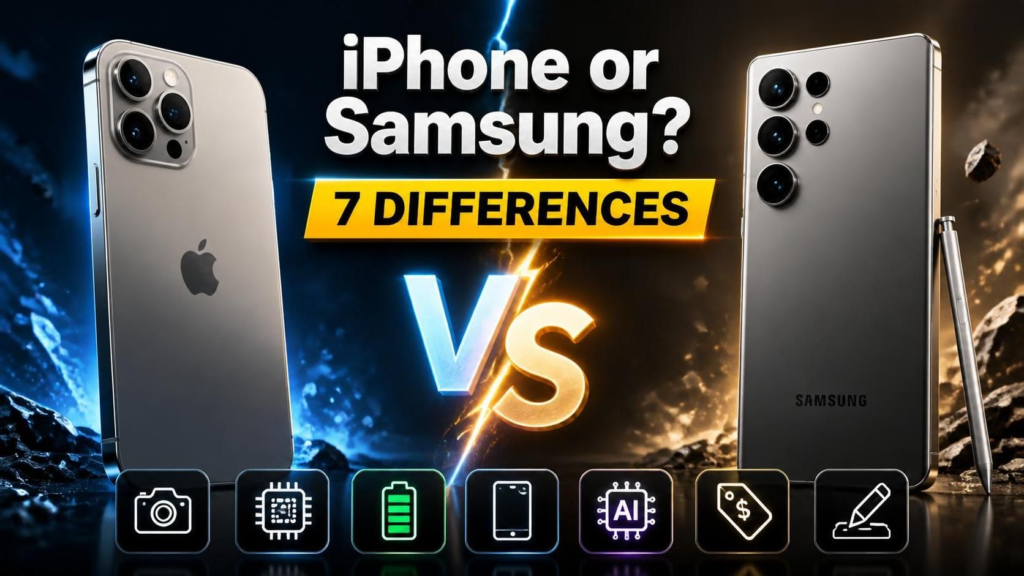
iPhone or Samsung? 7 Differences That Decide Your Choice Before Purchasing
📌 The Ultimate 2026 Buyer’s Guide: Breaking Down the Two Smartphone Giants So You Never Regret Your Decision
📑 Table of Contents
- 🎯 Introduction: The Eternal Debate
- 📊 At-a-Glance Comparison Overview
- 🔒 Difference #1: Operating System & Ecosystem Lock-In
- 🏗️ Difference #2: Hardware Design & Build Philosophy
- 📸 Difference #3: Camera Approach & Photography Style
- ⚡ Difference #4: Performance, Chipsets & Longevity
- 🎨 Difference #5: Customization, Freedom & Flexibility
- 💰 Difference #6: Price Strategy & Value for Money
- 🔄 Difference #7: Software Updates & Security Support
- 📋 The Verdict: Which One Should YOU Buy?
- ❓ Frequently Asked Questions
🎯 Introduction: The Eternal Debate
Walk into any electronics store, browse any tech forum, or ask a group of friends about their next phone — and you’ll inevitably hit the same crossroads: iPhone or Samsung? 📱
These two titans dominate the global smartphone market. Apple commands premium loyalty with its walled-garden ecosystem, while Samsung flexes its engineering muscle across every price bracket imaginable. But here’s the truth most “versus” articles won’t tell you: neither is objectively “better.” The right choice depends entirely on who you are, how you use your phone, and what you value most.
According to StatCounter’s 2026 mobile OS data, Android holds roughly 71% of the global market, while iOS captures about 28%. Yet in the premium segment (phones above $800), the race is neck-and-neck. Samsung and Apple are essentially fighting for the same wallet — yours.
This guide isn’t about fanboyism. It’s about seven concrete differences that will genuinely impact your daily life. By the end, you’ll know exactly which camp you belong to — or whether you should switch sides entirely.
📊 At-a-Glance Comparison Overview
Before we dive deep, here’s a quick snapshot of how these two giants stack up in 2026:
| Feature | 🍎 iPhone (iOS 26) | 📱 Samsung Galaxy (One UI 8) |
|---|---|---|
| Operating System | iOS | Android with One UI |
| Ecosystem | Closed, seamless | Open, flexible |
| Chipset | Apple A19 / A19 Pro | Snapdragon 8 Elite / Exynos 2600 |
| Camera Style | Natural, computational | Versatile, feature-rich |
| Customization | Limited, curated | Extensive, deep |
| Price Range | $799 – $1,599+ | $199 – $1,499+ |
| Update Support | 6-7 years | 7 years (flagships) |
| Repairability | Restricted (parts pairing) | Moderate (Self-Repair program) |
🔒 Difference #1: Operating System & Ecosystem Lock-In
The biggest decision you’ll make isn’t about megapixels or RAM — it’s about the operating system. iOS and Android (specifically Samsung’s One UI) offer fundamentally different philosophies.
🍎 The iOS Experience: It Just Works (Within the Garden)
Apple’s iOS is the definition of a walled garden. Everything is controlled, curated, and connected. When you buy an iPhone, you’re not just buying a phone — you’re buying into an ecosystem that includes the Apple Watch, AirPods, MacBooks, iPads, and services like iCloud, Apple Music, and Apple Pay.
The magic moments:
- 📲 AirDrop files instantly to any Apple device nearby
- 🎧 Seamless switching between iPhone, iPad, and Mac
- 🔐 iMessage & FaceTime — still the gold standard for encrypted communication
- ⌚ Apple Watch integration that no Android watch can truly match
The catch? Once you’re in, leaving is painful. Your iMessage threads, iCloud photos, Apple Watch, and App Store purchases create a gravitational pull that’s hard to escape. As The Verge notes in its ecosystem analysis, Apple has mastered “soft lock-in” — making the experience so smooth that alternatives feel broken.
📱 The Samsung/Android Experience: Freedom with a Learning Curve
Samsung’s One UI (built on Android) is the opposite philosophy. It’s open, adaptable, and unapologetically customizable. You can change default apps, sideload software from outside the Play Store, connect to Windows PCs via Link to Windows, and use standard USB-C accessories without proprietary restrictions.
The freedom perks:
- 🔌 Universal USB-C — one cable for everything
- 🖥️ DeX Mode — turn your phone into a desktop computer
- 📂 File system access — manage files like a real computer
- 🤝 Cross-platform compatibility — works with any brand
The trade-off? With freedom comes fragmentation. Settings are scattered across multiple menus. Features vary by region. And the “it just works” polish sometimes requires tinkering.
🏆 Verdict on Difference #1:
| You Should Choose iPhone If… | You Should Choose Samsung If… |
|---|---|
| You already own Apple devices | You use Windows PCs or mixed ecosystems |
| You value simplicity over control | You love tweaking and customizing |
| Privacy is your top priority | You want file system freedom |
| You want seamless device handoff | You prefer open standards (USB-C, etc.) |
🏗️ Difference #2: Hardware Design & Build Philosophy
Samsung and Apple approach hardware from opposite ends of the spectrum — and both have valid arguments.
🍎 iPhone: Precision Engineering & Material Obsession
Apple’s design language screams premium minimalism. The iPhone 16 Pro and 17 series feature:
- Grade 5 Titanium frames (lighter and stronger than steel)
- Ceramic Shield glass (developed with Corning)
- Precision-milled buttons with satisfying tactile feedback
- Symmetrical bezels that are mathematically identical on all sides
Apple controls every millimeter. The result? A phone that feels like a luxury object in your hand. The haptic engine alone — the Taptic Engine — is so refined that other manufacturers have been trying (and failing) to replicate it for years.
However, this obsession with perfection comes with costs:
- Repairability is notoriously difficult (hello, “parts pairing” restrictions)
- Design changes are incremental and conservative
- Physical customization is virtually nonexistent
📱 Samsung: Innovation-First, Feature-First
Samsung throws everything at the wall — and most of it sticks. The Galaxy S26 Ultra and Z Fold series showcase:
- Gorilla Glass Armor 2 with anti-reflective coating
- S Pen integration (on Ultra models) — a legitimate productivity tool
- Curved and foldable displays that push engineering boundaries
- Variable aperture cameras — hardware Apple hasn’t attempted
Samsung isn’t afraid to experiment. They launched foldables when everyone laughed. They put 200MP sensors in phones. They offer stylus support without buying a separate accessory (on Ultra models).
But: The plastic feel of mid-range Samsung phones can’t match iPhone’s consistency. And Samsung’s software sometimes feels like it’s trying to justify the hardware, rather than the other way around.
🏆 Verdict on Difference #2:
| iPhone Wins On… | Samsung Wins On… |
|---|---|
| Haptic feedback quality | Display innovation (foldables, etc.) |
| Material consistency across lineup | S Pen productivity integration |
| Premium “feel” in hand | Hardware experimentation |
| Long-term structural durability | Repairability options |
📸 Difference #3: Camera Approach & Photography Style
This is where the debate gets heated. Both companies make incredible cameras — but they see photography differently.
🍎 iPhone: Computational Photography King
Apple doesn’t chase megapixel counts. The iPhone 16 Pro Max “only” has a 48MP main sensor (in 2026 standards), yet produces images that rival dedicated cameras. Why?
Apple’s secret sauce:
- 🧠 Photonic Engine — AI-driven image processing that enhances detail before compression
- 🎬 ProRes LOG video — cinema-grade color grading for creators
- 🎥 Action Mode & Cinematic Mode — gimbal-like stabilization and focus pulling
- 🌅 Smart HDR 6 — balanced exposure in extreme lighting
iPhone photos look natural. Skin tones are accurate. Shadows retain detail. The philosophy is: “Don’t let the camera get in the way of the moment.”
The downside? iPhone cameras can look “boring” compared to Samsung’s punchy output. Zoom capabilities historically lagged behind Samsung’s periscope lenses (though Apple has closed the gap with tetraprism designs).
📱 Samsung: The Spec Sheet Champion
Samsung puts everything into its cameras. The Galaxy S26 Ultra features:
- 200MP main sensor — insane detail in perfect light
- 10x optical zoom — see things you shouldn’t be able to see
- 200MP wide-angle — because why not?
- Expert RAW app — manual controls that pros actually use
Samsung photos are vivid, saturated, and social-media-ready straight out of the camera. The “Scene Optimizer” boosts colors, sharpens edges, and makes food look delicious. For Instagram and TikTok, Samsung often delivers more “likable” images without editing.
The downside? Skin smoothing can look artificial. Night mode sometimes over-brightens scenes into daylight. And the camera app is cluttered with modes you’ll never use.
📊 Camera Comparison Table
| Scenario | 🍎 iPhone Result | 📱 Samsung Result |
|---|---|---|
| Portrait Mode | Natural bokeh, accurate edges | Aggressive blur, beautification |
| Low Light | Balanced, noise-controlled | Bright, sometimes overprocessed |
| Zoom (10x+) | Good (digital hybrid) | Excellent (optical periscope) |
| Video | Industry-leading stabilization | Very good, slightly behind |
| Food Photography | Realistic colors | Vibrant, appetizing colors |
| Pro Controls | Limited (third-party apps needed) | Built-in Expert RAW |
🏆 Verdict on Difference #3:
| Choose iPhone If… | Choose Samsung If… |
|---|---|
| You shoot professional video | You love zoom photography |
| You want natural, true-to-life colors | You want social-media-ready photos instantly |
| You edit photos in Lightroom/Photoshop | You want built-in manual camera controls |
| You prioritize consistency | You want the latest sensor technology |
⚡ Difference #4: Performance, Chipsets & Longevity
Raw power matters — but so does how that power ages over time.
🍎 Apple Silicon: The Efficiency Monster
Apple designs its own chips (the A-series), and the gap between Apple Silicon and Qualcomm’s Snapdragon has been narrowing — but Apple’s efficiency remains unmatched.
Why iPhones feel faster:
- 🧠 Vertical integration — Apple designs the chip, the OS, and the hardware. They optimize for each other.
- 🔋 Better performance-per-watt — the A19 Pro delivers flagship power while sipping battery
- 🎮 Console-quality gaming — titles like Resident Evil and Assassin’s Creed run natively
- ⏱️ Sustained performance — iPhones throttle less during heavy tasks
In benchmark tests by Geekbench, iPhones consistently lead in single-core performance — the metric that matters most for everyday responsiveness.
📱 Samsung: The Multitasking Workhorse
Samsung’s flagships use the Snapdragon 8 Elite (in most regions), which is objectively a beast. Where Samsung pulls ahead:
Samsung’s strengths:
- 🐏 More RAM — Galaxy S26 Ultra ships with 12GB-16GB vs iPhone’s 8GB
- 🖥️ Better multitasking — Samsung’s DeX and split-screen actually work for productivity
- 🎮 Emulation & sideloading — run retro games and apps Apple blocks
- 🔥 Thermal design — larger vapor chambers for sustained gaming
For power users who run multiple apps simultaneously, edit 4K video on-device, or use their phone as a laptop replacement, Samsung’s extra RAM and flexibility matter more than Apple’s single-core dominance.
🏆 Verdict on Difference #4:
| iPhone Wins On… | Samsung Wins On… |
|---|---|
| Single-app performance & responsiveness | Multitasking & RAM-heavy workflows |
| Gaming optimization (Apple Arcade) | Emulation & sideloaded apps |
| Battery efficiency per task | Thermal management under sustained load |
| Long-term speed retention (5+ years) | Raw spec sheet numbers |
🎨 Difference #5: Customization, Freedom & Flexibility
This is the most personal difference. It separates “phone users” from “phone enthusiasts.”
🍎 iPhone: Apple’s Way or the Highway
iOS offers curated customization. You can:
- Arrange widgets on your home screen (since iOS 14)
- Change app icons via Shortcuts (with annoying shortcuts banners)
- Set Focus modes for different times of day
- Choose your default browser (finally) and mail app
But you cannot:
- Move apps freely anywhere on the grid (they snap to top-left)
- Install apps outside the App Store (without jailbreaking)
- Change default SMS app
- Access the file system directly
- Customize the always-on display extensively
Apple’s argument is security and simplicity. And they’re not wrong — the App Store’s curation blocks most malware. But for tinkerers, iOS feels like a beautiful cage.
📱 Samsung: The Customization Playground
One UI on Samsung devices is Android customization taken to its logical extreme:
What you can customize:
- 🎨 Good Lock modules — redesign the entire UI, from navigation gestures to notification panels
- 🖼️ Theme Park — create system-wide color palettes and icon packs
- 📂 Home screen grids — place one app in the bottom-right corner if you want
- 🤖 Bixby Routines — automate everything based on time, location, or connected devices
- 📲 Sideloading — install apps from APK files, emulators, and alternative stores
Samsung even lets you remap the Bixby button, choose your own default apps for everything, and run two instances of the same app (Dual Messenger).
The trade-off? With great power comes occasional instability. Some Good Lock modules conflict. Some themes drain battery. And the settings menu is a labyrinth.
🏆 Verdict on Difference #5:
| Choose iPhone If… | Choose Samsung If… |
|---|---|
| You want a phone that “just works” | You love personalizing every pixel |
| You value security over flexibility | You want to run emulators or niche apps |
| You find settings menus overwhelming | You enjoy tweaking and optimizing |
| You want consistent UI across devices | You want your phone to feel uniquely yours |
💰 Difference #6: Price Strategy & Value for Money
Let’s talk money — because for most people, this is the deciding factor.
🍎 iPhone Pricing: Premium Only
Apple does not compete in the budget segment. The 2026 lineup looks like this:
| Model | Starting Price | What You Get |
|---|---|---|
| iPhone 16e | $599 | Entry-level, single camera, last-gen chip |
| iPhone 17 | $799 | Standard flagship experience |
| iPhone 17 Pro | $999 | Pro camera, titanium, A19 Pro |
| iPhone 17 Pro Max | $1,199 | Largest screen, best battery |
| iPhone 17 Ultra | $1,599 | Everything maxed out |
Apple’s value proposition is longevity. A $999 iPhone used for 6 years costs $0.45 per day. The resale value is also unmatched — Swappa data shows iPhones retain 60-70% of their value after two years, compared to 40-50% for Samsung flagships.
Hidden costs:
- No charger in the box
- Expensive proprietary accessories (MagSafe, AirTags)
- iCloud storage subscriptions ($0.99-$9.99/month)
- AppleCare+ is pricey but almost necessary
📱 Samsung Pricing: Something for Everyone
Samsung’s portfolio is vast:
| Model | Starting Price | Category |
|---|---|---|
| Galaxy A16 | $199 | Budget |
| Galaxy A36 | $349 | Mid-range |
| Galaxy S26 | $799 | Standard flagship |
| Galaxy S26+ | $999 | Large flagship |
| Galaxy S26 Ultra | $1,299 | Ultra-premium |
| Galaxy Z Flip 7 | $999 | Foldable (compact) |
| Galaxy Z Fold 7 | $1,799 | Foldable (tablet) |
Samsung dominates every price point. The Galaxy A-series offers 80% of the flagship experience for 40% of the price. And during sales (Black Friday, Amazon Prime Day), Samsung discounts aggressively — sometimes 30-40% off.
Value proposition: More hardware for your money upfront. But depreciation is steeper, and software support varies by model (7 years for flagships, 4 years for mid-range, 2 years for budget).
🏆 Verdict on Difference #6:
| iPhone Is Better If… | Samsung Is Better If… |
|---|---|
| You keep phones for 5+ years | You upgrade every 2-3 years |
| You resell/trade-in frequently | You want flagship features on a budget |
| You factor in resale value | You want the most specs per dollar |
| You prefer predictable pricing | You love hunting for deals |
🔄 Difference #7: Software Updates & Security Support
How long will your phone stay relevant? This difference has changed dramatically in recent years.
🍎 iPhone: The Longevity Champion (Historically)
Apple supports iPhones longer than any competitor:
- iOS support: 6-7 years of full OS updates
- Security patches: Often extend beyond OS support
- Delivery: Instant, simultaneous global rollout
- Quality control: Rigorous, rarely buggy
The iPhone XS (2018) received iOS 18 in 2025 — that’s 7 years of support. No Android manufacturer matched this until recently.
The catch? iOS updates are all-or-nothing. You can’t skip a problematic update, and Apple has been accused of planned obsolescence through battery throttling (though they now offer battery health transparency).
📱 Samsung: The New Longevity King (2024-2026)
Samsung shocked the industry by announcing 7 years of OS and security updates for Galaxy S24 and newer flagships — matching Apple for the first time.
Samsung’s update structure:
- Flagships (S/Z series): 7 years of OS + security updates
- Mid-range (A5x/A7x): 4 years OS + 5 years security
- Budget (A1x-A3x): 2 years OS + 3 years security
However, Samsung’s update delivery is slower. Updates must pass through Samsung’s One UI customization, then carrier certification, then regional rollout. A security patch released by Google in January might reach your Samsung phone in March.
📊 Update Comparison Table
| Aspect | 🍎 iPhone | 📱 Samsung |
|---|---|---|
| Years of support (flagship) | 6-7 years | 7 years (S24+) |
| Update speed | Immediate | 1-3 months delayed |
| Update consistency | Global, simultaneous | Varies by region/carrier |
| Security patches | Monthly, reliable | Monthly (flagships), quarterly (mid) |
| Feature additions | Major iOS releases only | One UI updates between OS versions |
🏆 Verdict on Difference #7:
| Choose iPhone If… | Choose Samsung If… |
|---|---|
| You want updates the day they’re released | You want the longest possible support promise |
| You hate waiting for security patches | You enjoy One UI feature drops between updates |
| You want guaranteed consistency | You have a recent flagship (S24 or newer) |
📋 The Verdict: Which One Should YOU Buy?
After analyzing these seven differences, here’s the honest truth:
🍎 Buy an iPhone If You Are:
- ✅ Deeply invested in the Apple ecosystem (Mac, iPad, Watch, AirPods)
- ✅ A content creator who prioritizes video quality and color accuracy
- ✅ Someone who values privacy and security above customization
- ✅ A user who keeps devices for 5+ years and wants hassle-free updates
- ✅ Someone who prefers simplicity and “it just works” reliability
- ✅ Willing to pay a premium for polish and resale value
Best iPhone Models in 2026:
- 🏆 iPhone 17 Pro Max — Best overall experience
- 💰 iPhone 17 — Best value in the lineup
- 🎬 iPhone 17 Pro — Best for creators (ProRes LOG)
📱 Buy a Samsung If You Are:
- ✅ A power user who loves customization and control
- ✅ A photography enthusiast who wants optical zoom and manual controls
- ✅ Someone who uses Windows PCs and wants seamless cross-platform integration
- ✅ A multitasker who needs DeX, split-screen, and S Pen productivity
- ✅ Budget-conscious but wants flagship features (Galaxy A-series)
- ✅ An early adopter excited by foldables and experimental tech
Best Samsung Models in 2026:
- 🏆 Galaxy S26 Ultra — Best Android phone overall
- 📂 Galaxy Z Fold 7 — Best for productivity/multitasking
- 💰 Galaxy A56 — Best value flagship killer
❓ Frequently Asked Questions
❓ Q1: Can I switch from iPhone to Samsung without losing data?
A: Yes, but it’s not seamless. Samsung offers the Smart Switch app to transfer contacts, photos, and messages. However, you’ll lose iMessage history, Apple Watch functionality, and App Store purchases. Plan for a 1-2 week adjustment period.
❓ Q2: Which is more secure — iPhone or Samsung?
A: iPhone, by design. iOS is a closed system with hardware-level encryption, App Store vetting, and features like Lockdown Mode for high-risk users. Samsung is secure for everyday use but Android’s openness creates a larger attack surface.
❓ Q3: Do Samsung phones slow down like old iPhones?
A: Modern Samsung flagships (S22 and newer) age much better than earlier generations. With 7 years of promised updates and more RAM, the “Android lag” stereotype is largely outdated — though iPhones still maintain smoother animations over time.
❓ Q4: Is Samsung’s camera really better than iPhone’s?
A: It depends on your definition of “better.” Samsung wins on versatility (zoom, manual controls, megapixels). iPhone wins on video, consistency, and natural color science. For social media, Samsung often produces more “pop.” For professional work, iPhone is preferred.
❓ Q5: Can I use Google services on iPhone?
A: Absolutely. Google Maps, Gmail, Google Photos, Drive, and Chrome all work excellently on iOS. However, you can’t set them as true defaults for everything (though iOS now allows default browser and mail app changes).
❓ Q6: Which has better battery life?
A: In 2026, it’s a tie. iPhone 17 Pro Max and Galaxy S26 Ultra both deliver all-day+ battery life with moderate use. iPhones are more efficient per task; Samsung phones have physically larger batteries. Your usage pattern matters more than the brand.
🎯 Conclusion
The iPhone vs. Samsung debate isn’t about finding a winner — it’s about finding your winner.
Apple sells an experience: seamless, polished, secure, and expensive. If you value simplicity, ecosystem integration, and long-term software support, the iPhone is worth every riyal, dirham, or dollar.
Samsung sells possibility: powerful, customizable, innovative, and accessible. If you want the freedom to make your phone truly yours, experiment with cutting-edge hardware, or get flagship power without flagship prices, Samsung is the obvious choice.
🏆 Final Word: Don’t let brand loyalty trap you. The best phone is the one that disappears into your life and helps you do what matters — whether that’s creating content, running a business, staying connected with family, or simply scrolling through memos at 2 AM.
Whichever you choose, buy it knowing why you chose it. That confidence is worth more than any spec sheet.
📅 Last Updated: September 2026
🔗 External Resources: