📌 An In-Depth Analysis of the Supply, Demand, and Geopolitical Forces Driving Up PC Component Costs in 2026
📑 Table of Contents
- 🌩️ Introduction: The Perfect Storm
- 🤖 The AI Gold Rush: How Artificial Intelligence Is Eating Silicon
- 🏭 The Supply Chain Squeeze: From TSMC to Tariffs
- 💰 The Cost of Progress: Why Advanced Manufacturing Is Prohibitively Expensive
- 🧠 DRAM & Memory: A Market Ruled by Oligopoly
- 💾 The SSD Paradox: When Storage Becomes Precious
- 🎮 GPUs: Caught Between Gamers and Giants
- 🌍 Geopolitics & Trade Wars: When Chips Become Chess Pieces
- 📈 Inflation, Logistics & Raw Materials
- 🛒 What Can Consumers Do? Strategies for Smarter Buying
- 📊 Component Price Impact Summary Table
- ❓ Frequently Asked Questions
- 🔮 Conclusion: When Will the Storm Pass?
🌩️ Introduction: The Perfect Storm
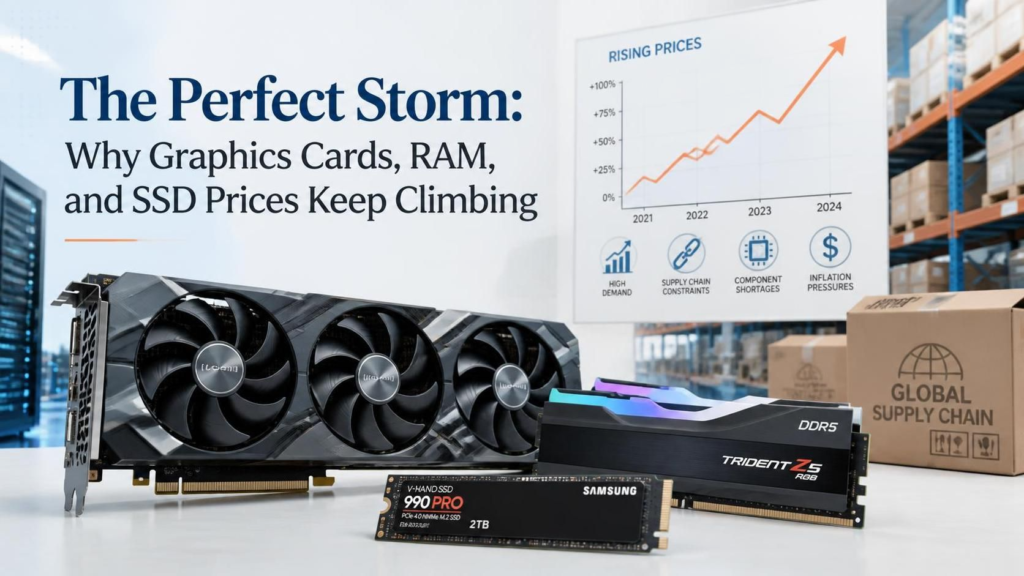
If you’ve tried building a PC, upgrading your laptop, or even just buying a pre-built gaming rig in 2026, you’ve probably experienced the same sticker shock that millions of consumers are feeling worldwide. Graphics cards that once retailed for $500 now command $700. A 32GB DDR5 kit that was affordable last year has jumped by 30%. And that 2TB NVMe SSD you bookmarked for later? It’s now 25% more expensive, if it’s even in stock. 😤
This isn’t a single cause. It’s a perfect storm — a rare and brutal convergence of multiple independent forces all hitting the PC component market simultaneously. On one front, the explosive growth of generative AI has created insatiable demand for high-bandwidth memory and cutting-edge GPUs. On another, geopolitical tensions are reshaping global semiconductor trade, introducing tariffs and export controls that ripple down to retail shelves. Meanwhile, the physics of silicon manufacturing is pushing against hard economic limits, making each new process node exponentially more expensive to build and operate.
According to TrendForce, a leading semiconductor market research firm, contract prices for DRAM and NAND flash have risen consecutively for multiple quarters through 2025 and into 2026. Tom’s Hardware has tracked GPU prices climbing well above MSRP across both NVIDIA and AMD lineups, while SSD prices have reversed years of decline. The question isn’t whether prices are rising — they undeniably are. The question is why, and more importantly, when will it end?
This guide breaks down every major force driving up the cost of graphics cards, RAM, and SSDs. By understanding the mechanics behind the market, you can make smarter purchasing decisions and know when to buy, when to wait, and what alternatives exist.
🤖 The AI Gold Rush: How Artificial Intelligence Is Eating Silicon
The single biggest disruptor in the component market isn’t a factory fire or a currency crash — it’s artificial intelligence. The generative AI boom that began with ChatGPT in 2022 has evolved into a full-scale infrastructure arms race among tech giants like Microsoft, Google, Amazon, Meta, and a host of well-funded startups.
How AI Impacts GPU Prices
AI training and inference require massive parallel compute power, and GPUs — originally designed for gaming graphics — happen to be the perfect tool for the job. NVIDIA’s data center revenue surpassed its gaming revenue years ago, and that trend has only accelerated.
| AI Demand Factor | Impact on Consumer GPUs |
|---|---|
| Data center priority | NVIDIA and AMD allocate best wafers to AI chips (H200, MI300X), reducing gaming GPU supply |
| HBM3E shortage | High-Bandwidth Memory used in AI GPUs competes for the same DRAM supply as consumer VRAM |
| CoWoS packaging bottleneck | Advanced packaging capacity is monopolized by AI accelerators, limiting gaming GPU production |
| AIB partner redirection | Board partners prioritize AI card assembly over consumer graphics |
💡 The Ripple Effect: When NVIDIA sells a single H100 AI accelerator for $25,000, it makes far more profit than selling ten RTX 5080 cards. TSMC’s limited leading-edge capacity naturally flows toward the highest-margin products. Gamers and creators are competing for the scraps.
How AI Impacts RAM & SSD Prices
AI doesn’t just consume GPUs — it devours memory and storage at an unprecedented scale.
- DRAM: Large language models (LLMs) require enormous amounts of high-speed memory. A single AI training cluster can use terabytes of DDR5 and HBM3E, pulling supply away from consumer modules.
- SSD: AI datasets are massive. Training runs generate petabytes of checkpoint data, driving enterprise SSD demand through the roof. When data centers buy every enterprise-grade NAND wafer they can find, consumer SSD production gets squeezed.
According to AnandTech, the AI sector’s demand for memory is projected to consume over 20% of global DRAM output by the end of 2026, up from single digits just three years ago.
🏭 The Supply Chain Squeeze: From TSMC to Tariffs
Even without AI, the semiconductor supply chain was fragile. Add geopolitical complexity, and it becomes a bottleneck.
The TSMC Bottleneck
Taiwan Semiconductor Manufacturing Company (TSMC) produces the vast majority of the world’s most advanced chips. Both NVIDIA’s RTX 50-series GPUs and AMD’s RDNA 4 GPUs rely on TSMC’s 4nm and 3nm process nodes.
| TSMC Challenge | Consumer Impact |
|---|---|
| Limited 4nm/3nm capacity | Fewer wafers available for gaming GPUs |
| Apple & Qualcomm priority | Mobile chips consume enormous early capacity |
| Equipment delivery delays | ASML EUV machine shortages slow fab expansion |
| Power & water constraints | Taiwan’s infrastructure limits 24/7 fab operation |
TSMC is building new fabs in Arizona, Japan, and Germany, but these facilities won’t reach full consumer-relevant capacity until 2027-2028. Until then, every square millimeter of Taiwanese silicon is precious.
AIB & Assembly Shortages
It’s not just the GPU die. The printed circuit boards (PCBs), voltage regulator modules (VRMs), capacitors, and chokes that surround the GPU core are also under pressure. When cryptocurrency mining or AI booms spike demand, board partners like ASUS, MSI, Gigabyte, and Sapphire struggle to secure enough components to meet orders.
💰 The Cost of Progress: Why Advanced Manufacturing Is Prohibitively Expensive
Moore’s Law isn’t dead, but it’s become prohibitively expensive. Each new process node requires astronomical investment.
The Rising Cost of Fabs
| Process Node | Estimated Fab Cost | Year |
|---|---|---|
| 28nm | ~$3 Billion | 2011 |
| 7nm | ~$10 Billion | 2018 |
| 5nm | ~$15 Billion | 2020 |
| 3nm | ~$20 Billion | 2023 |
| 2nm | ~$28 Billion | 2026 |
These costs must be recouped through higher chip prices. A GPU die on 4nm costs significantly more to manufacture than the same die area on 7nm, even before yield losses are factored in.
Yield Rates and Binning
Not every chip that comes off the wafer works perfectly. Yield rates — the percentage of functional dies — directly impact cost.
- Early production runs have lower yields, meaning fewer usable chips per wafer
- Complex designs (large GPU dies) have more transistors that can fail
- Binning sorts chips into tiers, but if overall yields drop, even lower-tier cards become scarce
When yields suffer, manufacturers raise prices to maintain margins. Consumers pay the difference.
🧠 DRAM & Memory: A Market Ruled by Oligopoly
The DRAM market is one of the most concentrated industries on Earth. Just three companies — Samsung, SK Hynix, and Micron — control roughly 95% of global supply. When they sneeze, the PC market catches a cold.
The Transition to DDR5 and Advanced Nodes
The industry is in the middle of a major transition:
| Transition Factor | Price Impact |
|---|---|
| DDR4 → DDR5 | DDR5 requires new equipment and materials; early production costs are higher |
| EUV lithography for DRAM | Samsung and SK Hynix are adopting EUV for finer memory cells, increasing capital expenditure |
| High-layer 3D NAND | 200+ layer NAND is complex to manufacture, affecting yields |
Supply Discipline
After years of brutal price wars that destroyed profitability, memory manufacturers have learned to practice supply discipline. Rather than flooding the market and crashing prices, they intentionally limit output to stabilize margins.
According to TrendForce, DRAM contract prices rose by 18-23% quarter-over-quarter in early 2026, driven by “strategic production cuts and robust AI server demand.”
HBM3E: The Memory Thief
High-Bandwidth Memory (HBM3E) is the ultra-fast stacked memory used in AI accelerators. Manufacturing HBM3E consumes 3x the wafer capacity of standard DDR5 for the same bit output. Every HBM3E stack produced means less capacity for consumer RAM.
| Memory Type | Primary Use | Wafer Efficiency |
|---|---|---|
| DDR5 | PCs, laptops, servers | Baseline |
| LPDDR5X | Smartphones, ultrabooks | Moderate |
| HBM3E | AI training GPUs | 3x less efficient |
💾 The SSD Paradox: When Storage Becomes Precious
For years, SSDs followed a predictable trajectory: capacity doubled, prices halved. That trend has stalled — and reversed.
NAND Flash Production Cuts
NAND flash manufacturers — Samsung, SK Hynix, Kioxia, Micron, and Solidigm — collectively slashed production in 2024-2025 to combat oversupply and restore profitability.
| Manufacturer | Action Taken | Impact |
|---|---|---|
| Samsung | Reduced NAND wafer starts by ~30% | Tightened supply |
| SK Hynix / Solidigm | Shifted capacity to enterprise SSDs | Fewer consumer drives |
| Kioxia | Delayed new fab expansion | Slower supply growth |
| Micron | Focused on high-margin QLC enterprise | Reduced TLC consumer output |
The QLC vs. TLC Shift
As manufacturers push for higher density, many consumer SSDs have shifted from TLC (Triple-Level Cell) to QLC (Quad-Level Cell) NAND. While QLC offers higher capacity per chip, it has lower endurance and performance.
| NAND Type | Bits per Cell | Endurance | Performance | Cost |
|---|---|---|---|---|
| SLC | 1 | 🏆 Excellent | 🏆 Fastest | Expensive |
| MLC | 2 | Very Good | Very Fast | Moderate |
| TLC | 3 | Good | Fast | Affordable |
| QLC | 4 | Lower | Slower | Cheapest |
Premium TLC drives have become scarcer as manufacturers prioritize QLC for mainstream products — and charge more for the remaining high-quality TLC inventory.
Enterprise Demand for SSDs
AI data centers don’t just need GPUs and RAM — they need fast storage. Training datasets and model checkpoints are stored on high-performance NVMe SSDs. When Amazon, Microsoft, and Google build new AI clusters, they buy enterprise SSDs by the pallet.
This demand pulls NAND supply away from consumer products. A 2TB consumer NVMe drive and a 2TB enterprise U.2 drive use the same underlying NAND chips. When enterprises pay premium prices, manufacturers follow the money.
🎮 GPUs: Caught Between Gamers and Giants
The graphics card market is experiencing a unique identity crisis. GPUs are no longer just for gamers — they’re the engines of the AI economy.
NVIDIA’s Market Dominance
NVIDIA commands roughly 80-85% of the discrete GPU market in 2026. This dominance gives them pricing power that AMD and Intel struggle to challenge.
| NVIDIA Strategy | Consumer Impact |
|---|---|
| AI-first allocation | Fewer gaming GPUs produced relative to AI chips |
| Premium pricing | RTX 50-series MSRPs set new highs for each tier |
| Founders Edition scarcity | Reference cards sell out instantly, forcing AIB premium prices |
| Software ecosystem lock-in | CUDA and DLSS make switching to AMD/Intel difficult |
AMD’s Position
AMD remains competitive in rasterized gaming performance, but they face the same manufacturing constraints as NVIDIA. The Radeon RX 9000 series is built on the same TSMC 4nm node that is being squeezed by AI demand.
AMD’s challenge is margin pressure. They can’t price too low without losing money on each card, but pricing too high risks losing market share to NVIDIA.
Intel’s Arc Struggle
Intel Arc has made remarkable progress, but Intel faces a different problem: profitability. Arc cards are often priced aggressively to gain market share, but Intel’s manufacturing costs (especially when using TSMC external fabs) mean they’re fighting for every sale. If Intel can’t achieve scale, their ability to undercut AMD and NVIDIA on price is limited.
🌍 Geopolitics & Trade Wars: When Chips Become Chess Pieces
Semiconductors are no longer just commercial products — they’re strategic national assets. The trade policies of the United States, China, Taiwan, and the European Union directly impact what you pay at the checkout.
US-China Export Controls
The US government’s export restrictions on advanced semiconductors to China have created ripple effects:
| Policy | Market Impact |
|---|---|
| Advanced GPU export bans | China stockpiles chips before bans, creating temporary shortages |
| Equipment restrictions | Chinese firms can’t buy advanced lithography, slowing global supply diversification |
| Tariffs on Chinese electronics | Higher import duties increase retail prices in the US and EU |
Tariffs and Trade Barriers
In 2025-2026, new tariffs on Chinese-manufactured electronics components have added 10-25% to the landed cost of GPUs, SSDs, and RAM modules in Western markets.
| Component | Typical Manufacturing Region | Tariff Exposure |
|---|---|---|
| GPUs (AIB cards) | China, Taiwan, Vietnam | High |
| DRAM modules | China, South Korea | Moderate |
| SSD assembly | China, Taiwan, Thailand | High |
| PCBs & passive components | China | Very High |
The CHIPS Act and Regionalization
The US CHIPS Act and similar European initiatives aim to bring semiconductor manufacturing back onshore. While this is strategically important long-term, the transition period is inflationary:
- New US and EU fabs cost more to operate than Asian counterparts
- Supply chains are being duplicated rather than expanded efficiently
- Short-term disruption exceeds long-term gains
📈 Inflation, Logistics & Raw Materials
Beyond silicon, the physical components of your PC are getting more expensive to make and ship.
Raw Material Costs
| Material | Use in PC Components | Price Trend |
|---|---|---|
| Copper | PCBs, VRMs, connectors | Rising |
| Gold | Bond wires, PCB traces | Volatile, elevated |
| Silicon (substrate) | Wafer manufacturing | Rising |
| Rare earth elements | Magnets in fans, capacitors | Geopolitically constrained |
| Epoxy resins | PCB lamination | Rising with oil prices |
Shipping and Logistics
Global shipping costs spiked during the 2020-2022 pandemic and have never fully normalized. Container shipping from Asia to North America or Europe remains 30-40% more expensive than pre-pandemic levels. Fuel costs, port congestion, and labor shortages add friction at every step.
Currency Fluctuations
For international buyers, currency swings amplify price increases:
| Currency | Impact on Component Prices |
|---|---|
| USD strengthening | Makes imports cheaper for Americans, expensive for others |
| EUR, GBP, JPY weakening | European and Asian consumers pay more in local currency |
| Emerging market currencies | Extreme volatility makes pricing unpredictable |
🛒 What Can Consumers Do? Strategies for Smarter Buying
You can’t control TSMC’s wafer allocation or Samsung’s NAND output. But you can make smarter decisions.
🛡️ Strategy 1: Time Your Purchases
| Component | Best Time to Buy | Worst Time to Buy |
|---|---|---|
| GPU | After major launches when older stock clears; during summer lulls | Immediately after launch; during holiday season |
| RAM | During oversupply cycles (watch TrendForce reports) | When contract prices are rising |
| SSD | During NAND production peaks; post-holiday sales | When manufacturers announce production cuts |
🛡️ Strategy 2: Consider Last-Gen Hardware
Last-generation components often offer 80-90% of the performance at 60-70% of the price:
- DDR4 is still excellent for most gaming and productivity tasks
- PCIe 3.0/4.0 SSDs are barely distinguishable from PCIe 5.0 in real-world use
- Previous-gen GPUs (RTX 40-series, RX 7000-series) offer outstanding value
🛡️ Strategy 3: Buy What You Need, Not What You Want
The “future-proofing” tax is expensive. A 16GB GPU, 32GB of RAM, and a 1TB SSD are sufficient for 90% of users.
🛡️ Strategy 4: Watch for Bundles and Promotions
Retailers sometimes bundle GPUs with RAM or SSDs at discounted rates to move inventory. These bundles can offset individual component inflation.
🛡️ Strategy 5: Consider Alternatives
| Instead Of | Consider |
|---|---|
| High-end NVIDIA GPU | AMD Radeon or Intel Arc for non-RT gaming |
| Brand-name DDR5 | Reliable second-tier memory with same chips |
| Premium TLC NVMe | Good QLC drive for game storage (not OS) |
📊 Component Price Impact Summary Table
| Factor | GPU Impact | RAM Impact | SSD Impact | Severity |
|---|---|---|---|---|
| AI/Data Center Demand | 🔴 Severe | 🔴 Severe | 🟡 Moderate | ⭐⭐⭐⭐⭐ |
| TSMC Capacity Constraints | 🔴 Severe | 🟢 Minimal | 🟢 Minimal | ⭐⭐⭐⭐⭐ |
| Memory Oligopoly | 🟡 Moderate | 🔴 Severe | 🟡 Moderate | ⭐⭐⭐⭐ |
| NAND Production Cuts | 🟢 Minimal | 🟢 Minimal | 🔴 Severe | ⭐⭐⭐⭐ |
| Geopolitics/Tariffs | 🟡 Moderate | 🟡 Moderate | 🟡 Moderate | ⭐⭐⭐⭐ |
| Manufacturing Costs | 🟡 Moderate | 🟡 Moderate | 🟡 Moderate | ⭐⭐⭐ |
| Shipping/Logistics | 🟢 Minimal | 🟢 Minimal | 🟢 Minimal | ⭐⭐ |
| Raw Materials | 🟢 Minimal | 🟢 Minimal | 🟢 Minimal | ⭐⭐ |
❓ Frequently Asked Questions
❓ Q1: Will PC component prices go down in 2026?
A: Unlikely to drop significantly. While price increases may slow, the structural drivers — AI demand, limited leading-edge capacity, and memory supply discipline — suggest prices will remain elevated through at least late 2026. Any relief will likely come in 2027 as new fabs come online.
❓ Q2: Is now a bad time to build a PC?
A: It’s not ideal, but it’s not catastrophic either. If you need a PC now, buy what you need and avoid overspending on premium components. If your current system works, waiting 6-12 months might yield modest savings.
❓ Q3: Why are GPUs more expensive than their MSRP?
A: MSRPs are increasingly “launch prices” that only apply to a tiny fraction of cards. AIB partners add premiums for better coolers, and retailers mark up prices based on supply constraints. When demand exceeds supply, market price always wins over MSRP.
❓ Q4: Are SSD prices going to keep rising?
A: NAND manufacturers have successfully engineered a supply-constrained market. Until they expand production or demand softens, consumer SSD prices will remain elevated. However, QLC drives may see modest decreases as production scales.
❓ Q5: Should I buy DDR4 or DDR5 in 2026?
A: For new builds, DDR5 is the pragmatic choice despite higher prices — motherboard compatibility and future-proofing favor it. For upgrades on existing DDR4 systems, staying with DDR4 is perfectly viable and much cheaper.
❓ Q6: Is the AI boom the only reason prices are high?
A: No. AI is the largest single factor for GPUs and DRAM, but SSDs are driven more by NAND production cuts. Geopolitics, tariffs, and manufacturing costs affect all three categories. It’s a multi-factor storm.
❓ Q7: Will Intel Arc GPUs stay cheap?
A: Intel has priced Arc aggressively to gain market share, but they face the same manufacturing cost pressures as AMD and NVIDIA. Don’t expect Arc to remain a “budget miracle” forever — prices will normalize as the brand matures.
🔮 Conclusion: When Will the Storm Pass?
The relentless climb in graphics card, RAM, and SSD prices isn’t a temporary blip — it’s the new normal shaped by structural shifts in the global economy and technology landscape. The AI revolution has permanently changed how semiconductor capacity is allocated. The days of abundant, cheap silicon for consumer PCs are behind us, at least for the medium term.
That doesn’t mean hope is lost. Markets adapt. New fabs in Arizona, Japan, and Europe will eventually add capacity. Memory manufacturers will eventually increase output when prices justify the investment. And technological shifts — like chiplet-based designs and advanced packaging — may reduce reliance on monolithic dies that strain the most expensive process nodes.
But for now, the perfect storm rages on. AI demand, geopolitical fragmentation, concentrated supply chains, and the sheer physics of advanced manufacturing have collided to make 2026 one of the most expensive years in PC building history.
🏆 Key Takeaway: The smartest move in 2026 is strategic patience. Buy only what you genuinely need, consider last-generation hardware for value, and avoid the temptation to pay inflated premiums for marginal performance gains. The storm will eventually pass — but until then, build smart, not impulsively.
📅 Last Updated: September 2026 | 🏷️ Tags: GPU Prices, RAM Prices, SSD Prices, PC Component Costs, Semiconductor Market, AI Demand, Chip Shortage, Tech Inflation
🔗 External Resources: